


Thursday Afternoon Pre-Conference Workshop
Building Rapport and Creating Community: What Standup Comedy and Acting Can Teach Us about Student Engagement
Biography
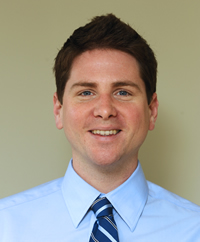
John holds a BFA in acting and a Master's in Library Science from Indiana University, Bloomington. Before he became a librarian, John was a professional actor. He uses his background in theatre to create engaging and memorable experiences in the classroom.
He was a 2011 Library Journal Mover and Shaker and a recipient of the 2012 ACRL Instruction Section Innovation award. He lives in Saint Louis with his dog, Otis. He can't believe he just mentioned his dog in this professional bio. How embarrassing.
Biography
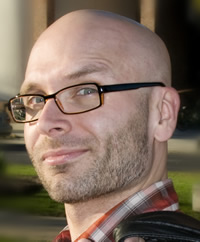
Joshua Vossler was born and raised in Grand Forks, North Dakota. He holds a Master's degree in English literature from the University of Arizona and a Master’s in library science from UNC Chapel Hill. He has ten years of experience teaching and designing credit-bearing courses, and his research interests include information literacy and the use of humor in the classroom.
He is the author of Humor and Information Literacy, and was a recipient of the 2012 ACRL Instruction Section Innovation Award (which, not by coincidence, was with John Watts).
Friday Morning Plenary Session
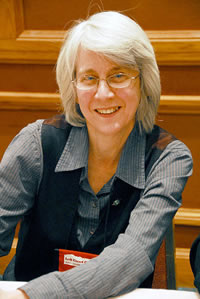 photo by Mark Coggins
Barbara Fister
Gustavus Adolphus College
Plenary Address: Decode Academy: The Library as a Meaning-Maker Space
Developing both the skills and the disposition to engage in inquiry is a ubiquitous if ill-defined goal of higher education. Libraries are a space, physical and social, where students practice a number of inquiry skills they can use after graduation to make a living--and, more importantly, to make a difference. But it’s hard to take the long view. Students are focused on completing assignments as efficiently as possible. Faculty want to cover content. Administrators want strong retention and completion rates. Who has time to think about what comes next? The information universe that librarians invite students to use is so complex that learning just enough to complete academic tasks saturates our instructional efforts, distracting us from a fundamental question: what experiences do we provide that support long-lasting and meaningful learning? How will what students learn in our libraries today help them make meaning in the information universe of the future?
Biography
Barbara Fister has coordinated instruction at the Gustavus Adolphus College library in St. Peter, Minnesota, for over 25 years, but is still learning how to help students learn. She has studied students’ research processes, examined the relationship between writing and research, and has taught an upper division course on how information works for students planning to go on to graduate education for several years.
Another of her interests is the future of publishing. She has written widely on open access to scholarship, is participating in a prototype exploration of publishing open access books through a library collaborative, has used PressBooks to publish an anthology of faculty writing, and is a founding editor of the new Journal of Creative Library Practice. She is proud to have served on the board of College and Research Libraries when it became a gold OA journal, though she cannot claim any credit for that innovation.
Popular literacy practices and the role of reading in everyday life is another thread of her work. An article on undergraduate pleasure reading that she co-authored with Julie Gilbert was written up in U.S. News and World Report. She has published research on crime fiction, most recently contributing an essay to an edited volume on Stieg Larsson’s Millennium Trilogy. She also writes her own crime fiction, having published three mysteries.
You can follow Barbara’s generalist tendencies on Twitter and through her regular posts for Library Journal’s Peer to Peer Review and her Library Babel Fish blog at Inside Higher Ed.
Saturday Morning Plenary Session
David A. Owens
Vanderbilt University
Plenary Address: Creative People Must Be Stopped! Managing Innovation When No One Wants to Change
Innovation is a natural outcome of human action and interaction, yet it is often systematically stopped in organizations and institutions by the very people who want it and who stand to benefit from it, be they students, teachers, staff, coworkers, or even the public at large. It seems like everybody wants innovation, but no one wants to change.
In this talk I’ll offer a framework for characterizing six types of these stoppages or “innovation constraints” to help you recognize, manage, and ultimately overcome the barriers that will stand in the way of your efforts to drive positive change and make the world a better place.
With a simple and straightforward understanding of the art and science of innovation, you can become much better at generating better ideas, assessing them in meaningful ways, and making sure that your best ideas get a fair chance to have an impact in the world. The goal is not only to give you some tools to help you better manage and lead innovation, but to show you how to improve your own ability to implement your creative ideas.
Biography
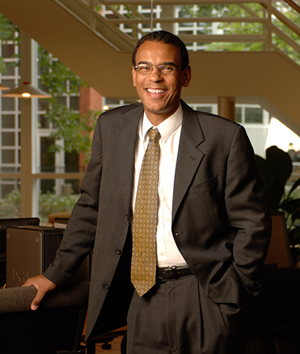
David A. Owens is professor of practice of management at Vanderbilt University's Owen Graduate School of Management, where he also directs the Executive Development Institute. Specializing in innovation and new product development, he is known as a dynamic speaker and is the recipient of numerous teaching awards. He provides consulting services for a wide range of clients around the world, and his work has been featured in the New York Times, Wall Street Journal, London Guardian and San Jose Mercury News, as well as on NPR's Marketplace.
Owens has consulted for NASA, The Smithsonian, Nissan LEAF, Gibson Music, American Conservatory Theater, Alcatel, Tetra Pak, Tennessee Valley Authority, Cisco, LEGO, The Henry Ford Museum and many other organizations. He has done product design work for well-known firms including Daimler Benz, Apple Computer, Dell Computer, Coleman Camping, Corning World Kitchen, Steelcase and IDEO Product Development. He has also served as CEO of Griffin Technology, a global company that specializes in iPod, iPhone and iPad accessories.
Owens earned his Ph.D. in management science and engineering through a joint fellowship program between Stanford's Graduate School of Business and its School of Engineering. He holds an M.S. in engineering product design and is a registered professional electrical engineer (P.E). In his current work, Owens focuses on concrete strategies for creating positive change in all types of organizations.
